
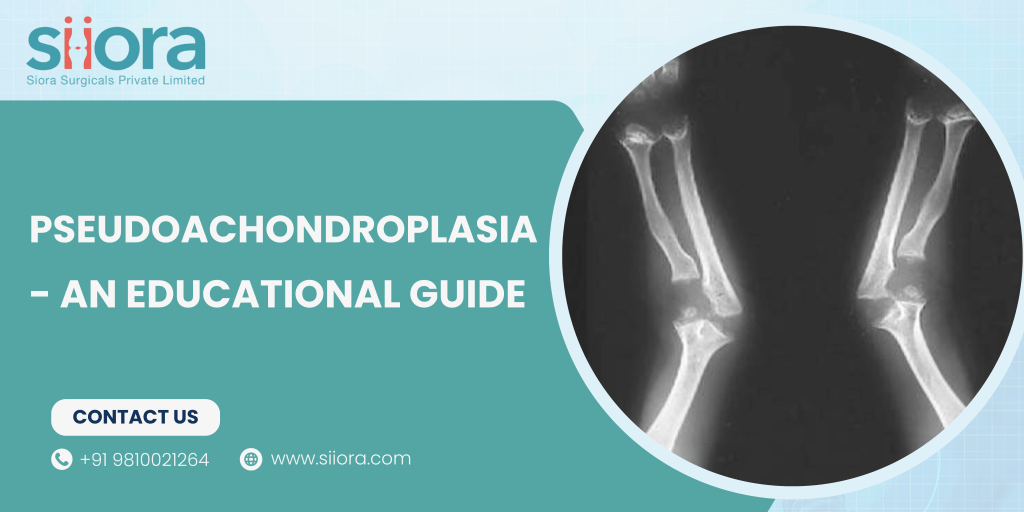
Pseudoachondroplasia is a type of bone disorder that is generally present by birth as an inherited condition. This occurs when the mother or father of the child has a defective gene that is passed to the offspring during birth.
It is a very rare condition in which the affected person has a short stature. Pseudoachondroplasia is also considered a type of dwarfism that is seen in around 1 out of 30,000 people according to studies. Children suffering from this condition may have an average-sized head & face but their stature will be short. Being a condition that occurs due to genetic mutation, it may not show any signs until the child becomes 2 years old.
This condition can affect any of the systems of our body and sometimes, hip or knee replacement surgery may be required. To get international standard quality artificial joints and other trauma implants, find trustworthy orthopedic supply companies.
In this post, we will talk about Pseudoachondroplasia in detail.
Pseudoachondroplasia – An Overview
Pseudoachondroplasia is an inherited bone disorder that is generally passed to the offspring at birth. It is also a type of dwarfism that results in short stature due to reduced skeletal growth. This is a rare condition that is also not easy to diagnose.
A single defective gene inherited from the parents causes Pseudoachondroplasia and besides this, there are certain other causes of the condition as well, that we’ll discuss later in the post.
What Are the Symptoms of Pseudoachondroplasia?
No signs and symptoms can be seen until the age of 9 months to 2 years. There may not be a delay in the time when a child starts to walk but, the gait might be abnormal, or the child might waddle while walking due to abnormalities in the hips.
The average height of adult males suffering from Pseudoachondroplasia is around 120 centimeters whereas, in females, it is around 116 centimeters.
Retarded growth rate, gait abnormalities, or other symptoms may appear at 2-3 years of age.
What Are the Causes of Pseudoachondroplasia?
The mutation of the COMP gene is the primary cause of Pseudoachondroplasia. Cartilage oligomeric matrix protein is known to assist COMP protein that surrounds ligaments, tendons, and bone-forming cells.
Pseudoachondroplasia can also develop after the birth of the child where a new de novo gene mutation occurs. In such cases, no family history of such a condition will be there.
What is the Diagnosis for Pseudoachondroplasia?
Several tests may be required to correctly diagnose the condition and for that, it is important to consult a specialist. Being an extremely rare condition, multiple tests like x-rays, CT scans, MRI, and EOS imaging may be required.
EOS imaging is executed while the patient assumes an upright stance. This helps the healthcare service provider identify weight-bearing positions. Genetic testing may help detect abnormalities in the DNA and confirm the condition.
What is the Treatment of Pseudoachondroplasia?
Pseudoachondroplasia can affect multiple systems in our body that may be different from child to child. So, the treatment will depend on what symptoms you have.
Spinal problems and osteoarthritis are on the cards in people suffering from Pseudoachondroplasia and hence, this will be taken into consideration while deciding the treatment. This condition can be managed by both surgical and non-surgical options, and that depends upon the severity of the condition.
Spinal fusion is one of the most recommended procedures that are performed to fix severe spinal injuries. If feasible, a back brace may be used to provide support to the spine in non-severe conditions. Besides this, physical therapy, and medication to relieve pain may also be helpful.
During the treatment, the healthcare service provider will keep monitoring the child for degenerative disc disease over time. In some cases, knee or hip joint replacement may be recommended to correct gait abnormalities in the later stages of life. This is not uncommon in people suffering from Pseudoachondroplasia.
Neurological problems may also be associated with the condition and hence, the treatment may be changed with time to minimize the risk of development of a new issue.
To get a CE-certified range of trauma implants, explore the inventory managed by Siora Surgicals Pvt. Ltd. The company specializes in producing an extensive range of orthopedic devices in different sizes. Siora uses medical-grade stainless steel and titanium to manufacture implants, and they are tested for strict quality parameters before being sent to the inventory for export. To stretch its international presence, the company is also looking to become one of the best Orthopaedic Device Companies in Ukraine.
 Siora Surgicals Pvt. Ltd.